
Drone vs traditional access
Where each access method wins.
Drone cleaning wins on large exterior elevations where access drives the price. Hands-on methods win when direct contact, close inspection, interior work, or restoration drives the result. SkyPSI uses both.
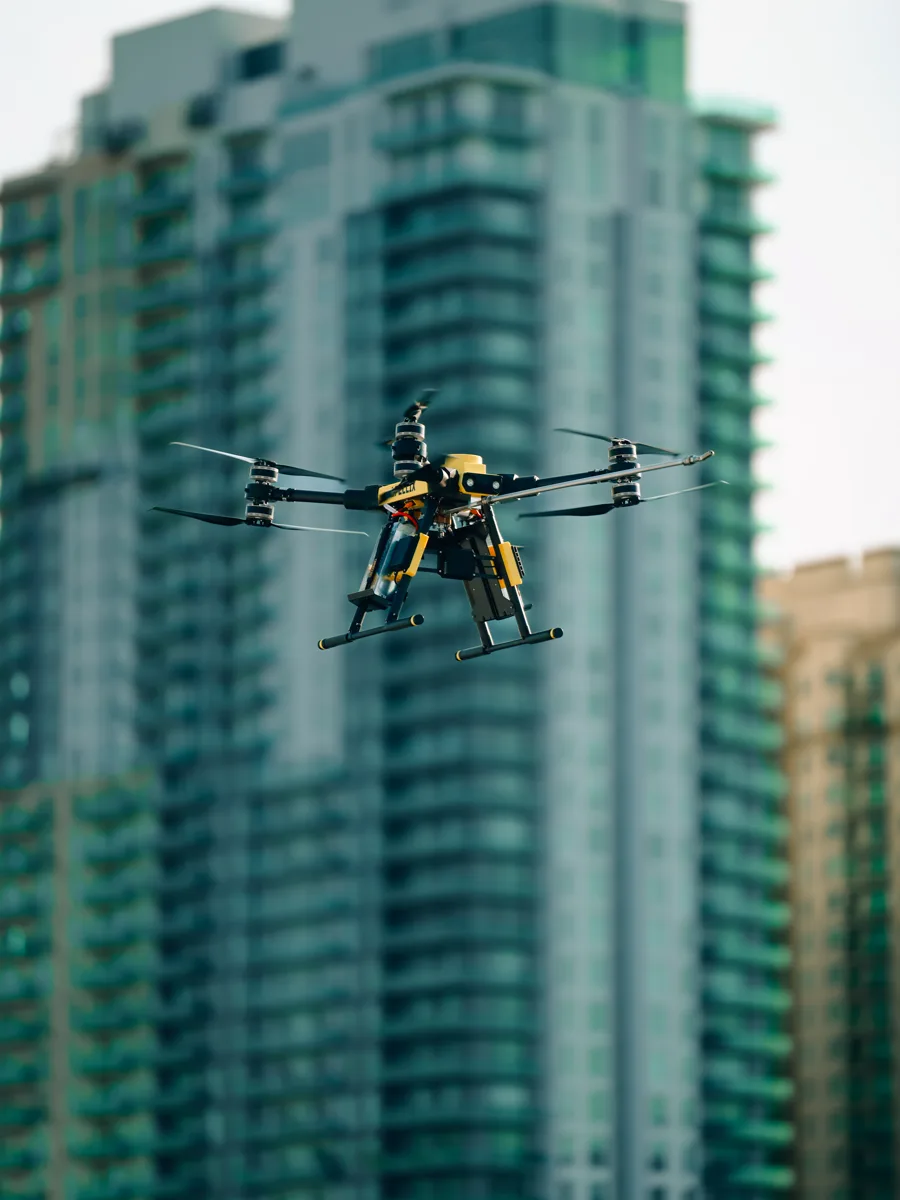
Choose access by elevation.
| Decision | Aerial | Rope | Lift / stage | Ground / hands-on |
|---|---|---|---|---|
| Best use | Large exterior elevations and recurring maintenance | Direct contact and detailed work at height | Reachable elevations with stable staging | Accessible glass, interiors, and detail |
| Height and geometry | Broad reach, governed by site and flight plan | Anchor and drop-path dependent | Equipment reach and ground-bearing dependent | Lower elevations and accessible interiors |
| Surface contact | Water or solution delivery without direct agitation | Direct tools and agitation | Direct tools and agitation | Direct tools, poles, and restoration |
| Ground footprint | Compact operating and exclusion area | Drop zones and roof access | Equipment, lane, and staging space | Localized crew and equipment area |
| People at height | Equipment works at elevation | Technicians work suspended | Technicians work from elevated platform | Work stays at grade or inside |
| Setup and repositioning | Flight and hose position change with the elevation | Rigging and drop changes | Equipment movement and reset | Pole, ladder, or crew repositioning |
| Detail capability | Strong for area cleaning | Strong for close inspection and detail | Strong for reachable hands-on detail | Strong for interiors, frames, tracks, and restoration |
| Hybrid role | Covers the high-area exterior | Handles select drops that require contact | Handles obstructed or repair-focused elevations | Completes lower, interior, and detailed scope |
Use the right tool for the reason it wins.
Choose aerial for access-driven elevations.
- Large exterior glass or facade area
- Recurring maintenance condition
- Lift staging is constrained
- Closures would burden occupants
- Reducing time at height is a priority
- Airspace, weather, water, runoff, and surroundings support flight
Choose hands-on for contact-driven work.
- Bonded mineral deposits
- Construction debris or heavy restoration
- Frames, tracks, screens, seals, and detailed inspection
- Interior glass and atriums
- Restricted elevations or airspace
- Surfaces that require direct contact
Most buildings use a mix of methods.
Aerial cleaning handles the high-area elevations. Water-fed systems cover accessible glass. Restoration crews address bonded deposits. Traditional access remains where direct contact or inspection is required. One proposal records which method applies where.
Reduce work at height and its cost.
Aerial cleaning moves the equipment to the elevation while the team operates from the ground. That changes both the exposure profile and the equipment, rigging, rescue, and site-control burden carried by traditional high-access work.
OSHA requires rope-descent anchorages capable of supporting at least 5,000 pounds per employee attached, plus independent fall arrest and prompt rescue capability.
OSHA rope-descent rule ↗In 2024, 844 U.S. workers died from falls, slips, and trips.
Bureau of Labor Statistics ↗Access method questions
It is highly effective for large exterior elevations in maintenance condition. Direct-contact methods remain stronger for bonded deposits, detailed components, restoration, and close inspection.
Aerial cleaning can remove major access and mobilization costs on large high-rise elevations. The lowest complete-property price often comes from assigning a different method to each part of the building.
Yes. SkyPSI coordinates aerial, water-fed, restoration, interior, pressure or soft washing, conventional, and hybrid delivery under one proposal.
One building. Every method available.
Pay for the right access method.
Request a QuoteThe site review sets the method boundary. Surface condition, airspace, surroundings, weather, access, and finish determine which elevations use aerial or hands-on delivery.