
Field Engineering
Cleaning Drones Above 200 Feet
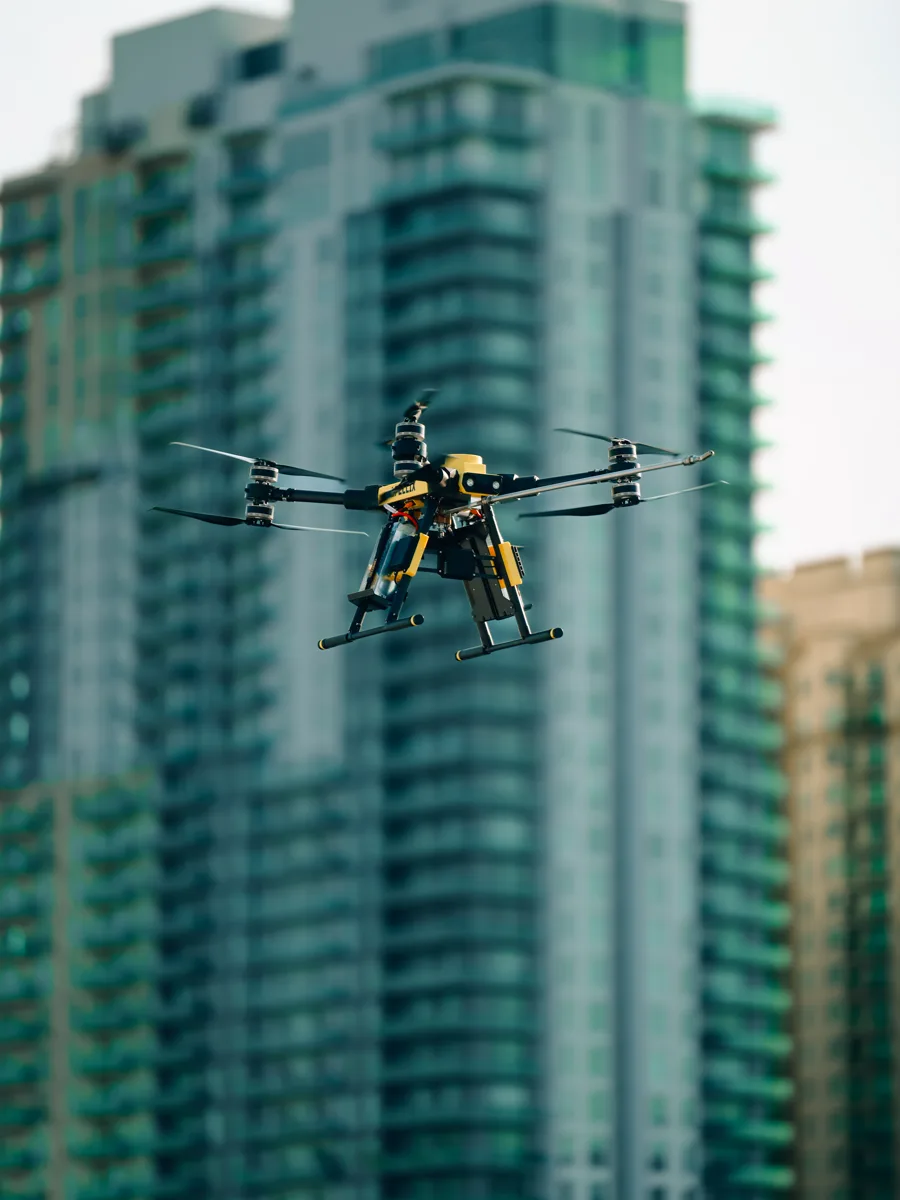
Part 107 puts the ordinary ceiling at 400 feet above ground level, and a structure rule can allow more near a building. The live hose decides the job. At height, hose weight, water, drag, wind, fittings, snags, and emergency recovery become the mission. The Apellix B2 reaches up to 195 feet.
195 FT
Working height
The B2 reaches up to 195 feet, about 16 stories. Part 107 covers aircraft under 55 pounds with everything attached.
[01]
The FAA ceiling is 400 feet
Part 107 generally permits flight up to 400 feet above ground level. Its structure rule can allow a drone to fly higher while it stays close to a structure and within 400 feet of that structure's uppermost limit. Controlled-airspace authorization, visual line of sight, people, weather, and site control apply at every altitude.
Allowed altitude and authorized airspace altitude are different numbers. The surrounding airspace, launch area, and line of sight can close a building that is physically reachable.
[02]
The hose becomes part of the aircraft
The under-55-pound definition includes everything attached. The calculation covers the supported hose, the liquid inside it, fittings, nozzle, and any power tether.
Static weight is only the start. Wind creates drag. A roof edge creates friction. A bend or snag can produce a sudden side load. Spray reaction and moving water change handling. A scale proves one number on the ground, and the crew proves controllability in the air.
[03]
Tie-offs are engineering work
A manufacturer-approved, rated support point can relieve some static hose load. It can also introduce anchor failure, abrasion, tension, snag, façade damage, and emergency-descent problems. The goal is hose-load relief. An aircraft-mounted counterweight adds mass to the aircraft.
A workable plan needs manufacturer approval, property permission, a rated anchor or management system, abrasion protection, a predictable release path, and a site-specific job safety analysis. The attached hose stays in the FAA weight analysis with the tie-off in place.
[04]
Where the B2 tops out
The Apellix B2 reaches up to 195 feet. Work above that configuration takes a different engineering and regulatory answer, and an operating weight of 55 pounds or more moves the flight onto a separate FAA path.
Height is a configuration the crew proves before takeoff: aircraft, hose, water, support method, airspace, visual line of sight, exclusion zone, weather, and recovery plan.
Sources
- [1]14 CFR 107.51, operating limitations
- [2]14 CFR 107.41, controlled airspace
- [3]14 CFR 107.31, visual line of sight
- [4]14 CFR 107.3, small-aircraft definition
- [5]14 CFR 107.49, aircraft and external-load preflight
- [6]FAA Section 44807 certification pathway
- [7]Manufacturer operating manual filed in the FAA docket
- [8]Apellix B2 specifications
Build With SkyPSI
Build around work your system can deliver.
A cleaning business can run several methods across one property list. SkyPSI brings equipment, commercial training, and support so you can price the drone work and plan other methods for the rest.