
Duty Cycle Versus Mobility
Power Tether vs. Longer Flight Time for Cleaning Drones
A cleaning drone already carries a wash hose. Ground power adds a second line and can remove battery stops. Hose drag, height limits, generator support, and repositioning remain. Longer battery flight time suits mobile work. A power tether earns its place on long, mostly stationary scopes.
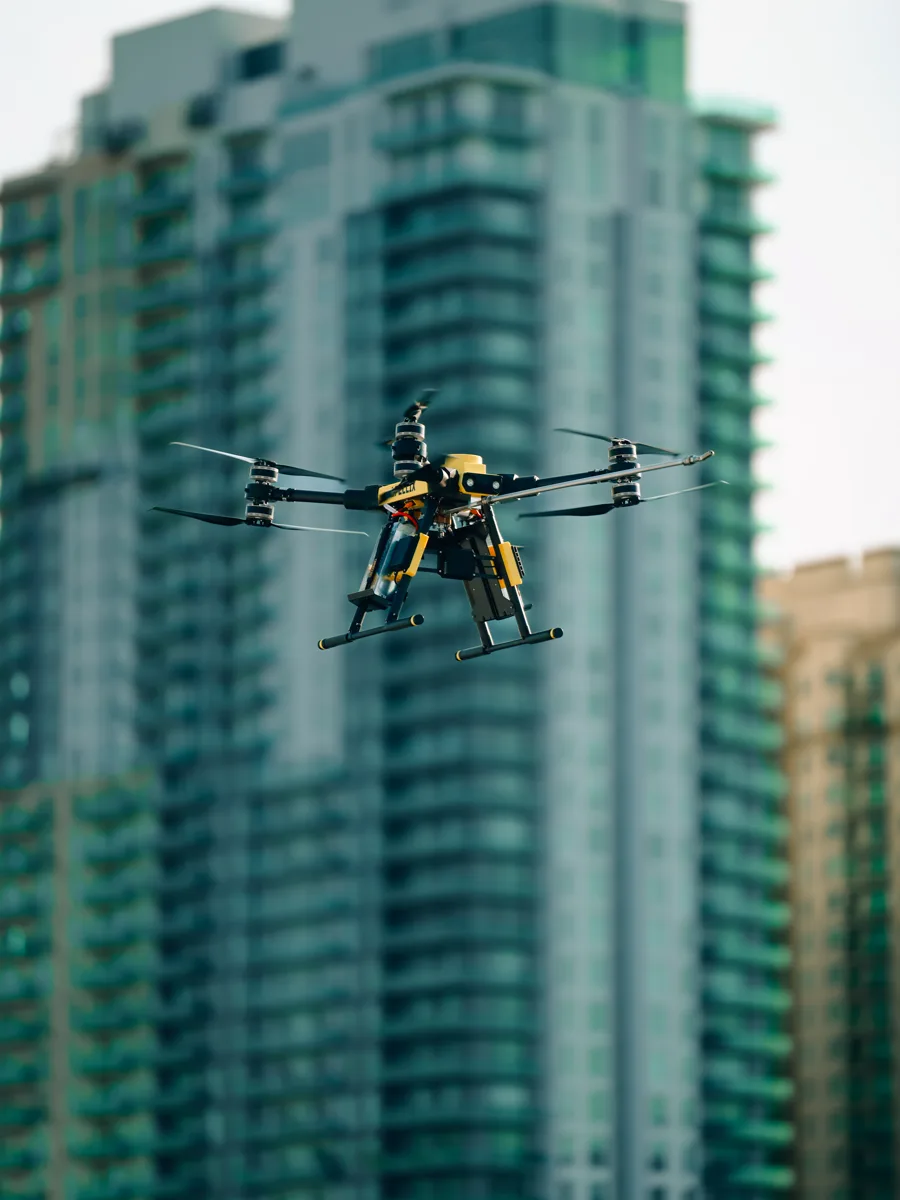
2 LINES
Wash hose plus power cable
Ground power removes battery cycling by adding another airborne connection.
[01]
Ground power solves one problem by adding a system
Lucid's Sherpa Power Tether uses a 200-foot power cable, ground station, air module, generator connection, and onboard emergency battery. The wash hose remains. The manufacturer requires the cable to be fully unspooled and inspected and specifies a generator with at least 10,000 running watts.
Installation takes under 15 minutes, and Lucid tested eight hours of continuous flight. On a suitable site, scheduled battery stops disappear.
The trade is added setup, generator support, electrical cable management, a second airborne line, and another route that must remain dry, protected, visible, and clear of people, vehicles, landscaping, projections, and the wash hose.
[02]
The hose defines the cleaning envelope
Cable length and cleaning height are different numbers. The tethered Sherpa reaches approximately 140 feet with the high-pressure hose and 110 to 115 feet with the soft-wash hose. Hose size, weight, rigidity, wind, payload, and current draw set the limit.
The B2 reaches up to 195 feet on batteries. The wash hose stays the binding constraint in both configurations.
| Constraint | Longer-flight battery operation | Ground-power operation |
|---|---|---|
| Airborne lines | Wash hose | Wash hose plus power cable |
| Scheduled stops | Battery transitions remain | Battery transitions can be removed |
| Ground support | Charging and battery handling | Ground station, generator, electrical routing |
| Mobility | Simpler repositioning | Cable and ground station move with the work |
| Working height | Limited by complete hose-and-aircraft system | Still limited by hose, cable, wind, and configuration |
Use the exact manufacturer configuration and the actual site. Cable length and working height are separate numbers.
[03]
Longer flight time attacks the same interruption
The B2 flies up to 32 minutes versus 19 for the Sherpa. More time per leg reduces how often the crew pays the descend, land, change, check, relaunch, and reposition penalty. It adds no second airborne cable.
For 240 airborne cleaning minutes, a 32-minute maximum implies seven transitions before reserves and site deductions. If each complete transition costs three, five, or ten minutes, the modeled interruption is 21, 35, or 70 minutes. A ground-power system earns a time advantage only when avoided transition and charging time exceeds its setup, cable repositioning, and generator interruptions.
[04]
Where a power tether genuinely wins
Ground power is strongest on one broad, contiguous face with a clear staging area, limited repositioning, compatible height, calm conditions, protected cable routing, and enough continuous cleaning time for avoided battery stops to exceed setup and line-management cost.
Longer battery endurance is stronger when the crew must move around corners, cross disconnected faces, relocate the rig, work near traffic or landscaping, reach beyond the tested tether-and-hose envelope, or simplify ground logistics.
Aircraft weight and energy demand can make continuous ground power more attractive. The tether is a duty-cycle tool for the Sherpa. It extends working time, and cleaning reach stays with the hose.
[05]
The practical choice
Start with the property map. Count work faces, moves, corners, pedestrian crossings, generator locations, and required height. Then compare the measured complete battery transition with the measured tether setup and reposition process.
For SkyPSI, longer flight time is the default advantage because it preserves mobility and attacks the landing penalty directly. Ground power is a site-specific exception when the scope is long, stationary, and comfortably inside the proven operating envelope.
Build With SkyPSI
Choose equipment for the workday.
Mobility, setup, and crew time affect the economics of a commercial clean. SkyPSI pairs the B2 flight kit with practical training and support, then adds marketing guidance as you build your own account base. Compare the complete operation.