
SkyPSI Exterior-Cleaning Standard
Choose the Right Exterior Cleaning Pressure
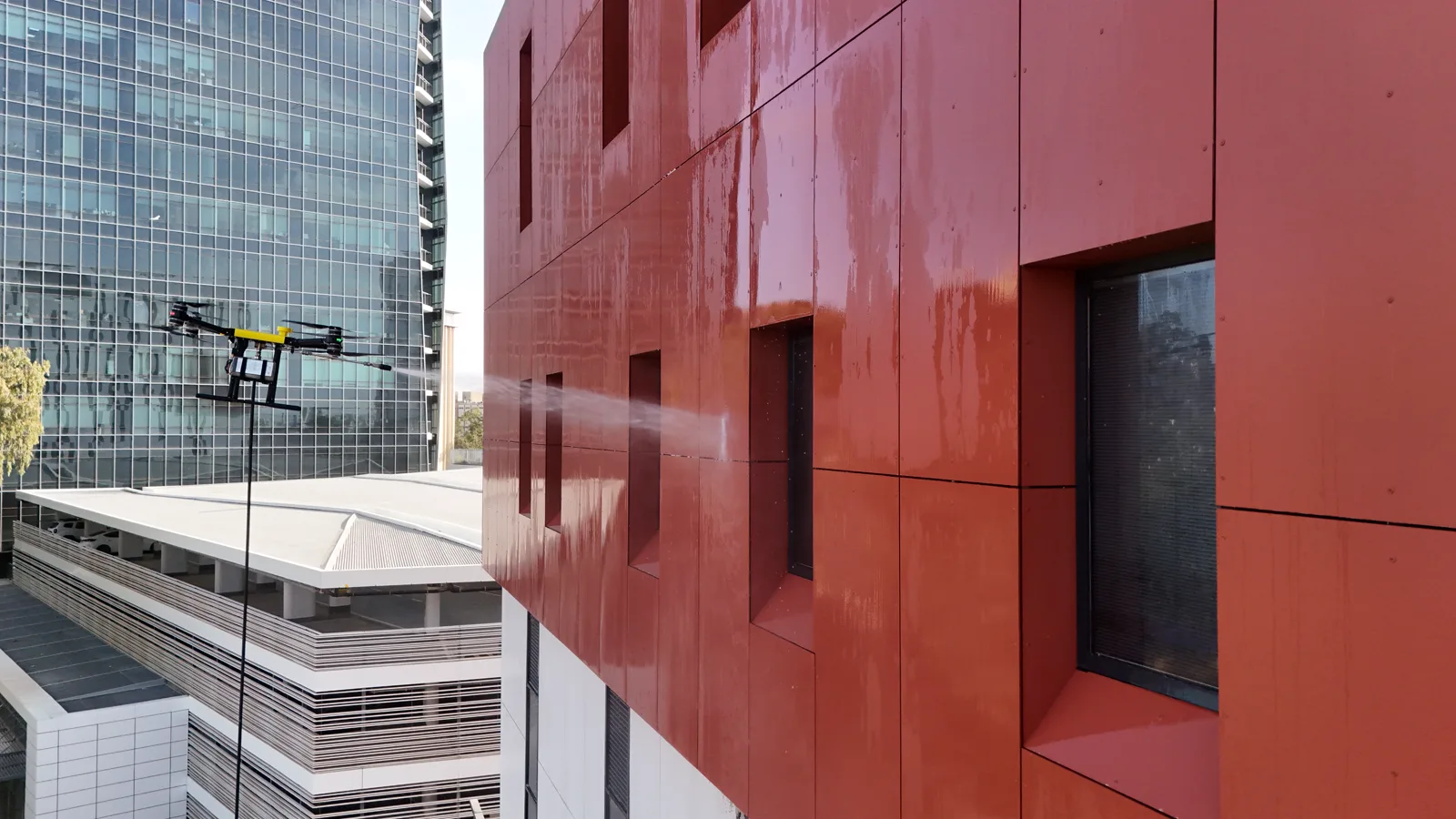
SkyPSI owns the finished property outcome, so pressure selection matters. The ground rig creates pressure and flow. The drone carries and aims the hose and nozzle while countering reaction force. The right setting is the lowest validated pressure that removes the contamination and leaves the surface intact.
4,000 PSI
Maximum working pressure
A hard ceiling. Most building cleaning runs far below it.
[01]
Pressure matters because the surface has to survive
Too much pressure can etch masonry, strip coatings, open window seals, drive water behind a facade, damage siding, and turn a cleaning job into a restoration problem.
The B2 tops out at 4,000 PSI at the ground pump. The Sherpa lists 4,500 PSI of equipment capacity, and Lucid high-pressure guidance recommends moderate pressure with higher flow for common work. Both figures describe equipment envelopes. The surface sets the cleaning recipe.
SkyPSI caps every exterior-cleaning workflow at 4,000 PSI. The surface manufacturer, coating, sealants, test patch, nozzle, chemistry, and required finish often set a much lower limit, and some surfaces rule out pressure washing.
[02]
The rig makes the pressure
The ground pump supplies water flow and creates system pressure. The hose then loses pressure through length, internal diameter, fittings, elevation, and flow. Lifting water consumes approximately 0.433 PSI per vertical foot before friction losses.
At the working end, the nozzle converts hydraulic pressure into water velocity and spray pattern. Orifice size, fan angle, wear, and standoff determine how concentrated the impact is at the surface. Chemistry and dwell time can loosen contamination so the rinse needs less force.
The drone accepts the physical consequences of that ground-created system. It supports part of the hose and fluid, carries the nozzle, holds standoff, and counters hose drag, wind, and nozzle reaction. Higher pressure can increase the control burden when the valve opens or the aircraft changes direction.
[03]
Start with the material
The table below is a conservative screening guide. The product manufacturer, coating manufacturer, project specification, cleaner label, and test patch control the final setting. Unknown, cracked, delaminated, repaired, or leaking assemblies stop the workflow until the surface is identified.
| Surface | Initial screen | Why |
|---|---|---|
| EIFS / Dryvit | 30-50 PSI application; normally below 600 PSI rinse | Dryvit warns that high pressure can drive cleaner through the finish |
| Sound masonry or concrete | 400-1,000 PSI rinse | PROSOCO warns that more than 1,000 PSI may permanently damage sensitive masonry |
| Painted or coated panels | Soft-wash territory; validate before increasing | Excessive pressure can alter or remove finishes |
| Exterior windows, frames, seals | No high-pressure washing | FGIA warns that high-pressure spray can damage seals, gaskets, and frame components |
| Fiber-cement siding | No pressure washer unless the exact manufacturer approves | James Hardie says pressure washing can damage the surface |
| White or decorative brick | No pressure washing until approved | Acme says pressure washers may alter the appearance of white brick |
| Roofing or unknown surfaces | Stop and use the governing manufacturer method | Surface identity sets the method |
Always start at the lowest practical pressure, use a broad compatible pattern where allowed, test an inconspicuous area, and inspect the result after it dries.
[04]
Where the 500 PSI difference matters
Lucid's 4,500 PSI maximum is higher than Apellix's 4,000 PSI maximum at the pump. That is Lucid's one clear peak-spec advantage in the direct hardware comparison.
Lucid guidance puts operators in the 2,700 to 3,500 PSI range with higher flow for its high-pressure payload. Surface manufacturers often require far less. Glass, EIFS, siding, coated metal, sealants, and decorative brick call for lower pressure or another method, so the extra 500 PSI sits unused.
More pressure is useful only when the surface, contaminant, nozzle, flow, standoff, and test result support it. Past that point it adds overspray, reaction force, wear, risk, and potential damage without improving the finished result.
[05]
The SkyPSI pressure-selection sequence
Identify the substrate, coating, joints, openings, repairs, and contamination. Read the manufacturer instructions and chemical safety data. Protect occupants, landscaping, air intakes, electrical systems, vehicles, and runoff routes.
Select chemistry, dwell time, water quality, flow, nozzle, fan angle, and standoff before increasing pressure. Test the lowest practical setting in an inconspicuous area, let it dry, and inspect for etching, gloss change, coating loss, water entry, joint movement, streaking, or discoloration.
Some damage appears only after drying, so judge the test dry. If the material cannot be identified or the manufacturer prohibits pressure washing, use another cleaning method.
Sources
- [1]Apellix B2 product page: 4,000 PSI maximum at pump
- [2]Lucid: Utilizing High Pressure with the Sherpa
- [3]General Pump spray-tip engineering chart
- [4]DryvitCARE EIFS repair and cleaning procedures
- [5]PROSOCO Custom Masonry Cleaner product data sheet
- [6]James Hardie siding cleaning guidance
- [7]FGIA window, door, and skylight care guidance
- [8]Acme Brick cleaning guidance
- [9]CDC pressure-washer safety guidance
- [10]OSHA Hazard Communication Standard
Build With SkyPSI
Good method judgment protects the job.
Knowing which method fits a surface helps you deliver work a property team will buy again. SkyPSI brings commercial field training, equipment, and front-line support together. The right pressure is one decision inside that complete operation.